
Arranging auditions, organising rehearsals, managing budgets, drafting contracts, planning press nights – and just occasionally moving tables and booking meeting rooms. There isn’t really a typical day when you’re a trainee producer.
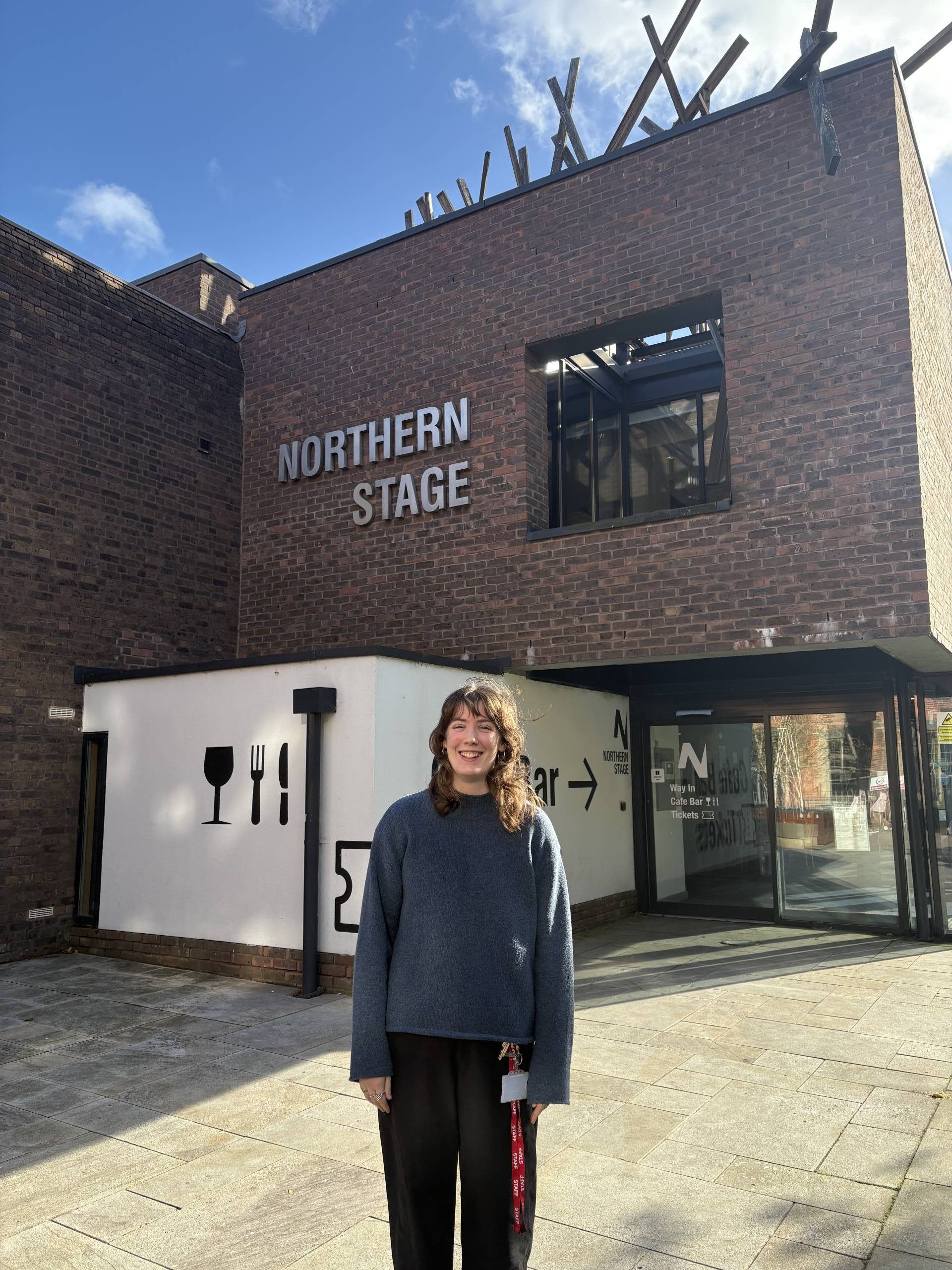
Over the past year, Laura Lydon has been finding that out first-hand as Trainee Producer here at Northern Stage.
Funded through Stage One, the year-long placement is designed to give people at the beginning of their producing careers the chance to learn on the job, building practical experience while being supported by experienced producers.
As Laura comes to the end of her year with us, we caught up with her about what a producer actually does, the productions she’s worked on, and why seeing a show come together after months of work is still one of the best bits of the job.
What Does A Trainee Producer Do?
The short answer? A bit of everything.
Laura studied dance before spending some time working at Dance City here in Newcastle, where she began getting involved in artistic programming and producing. She quickly realised she loved the combination of creativity and organisation that producing offered but, like lots of people at the beginning of their careers, found that many roles wanted experience she hadn’t yet had the opportunity to gain, which is what made the Trainee Producer placement stand out.
“A lot of things are just like, here’s a job, either you fit into it, or you don’t,” Laura explains. “Whereas this role was going to give you all the skills for doing it.”
During her year at Northern Stage, Laura has worked across the whole process of making and presenting theatre. She’s supported casting and auditions, prepared contracts, set up payroll, coordinated creative teams, organised meetings and rehearsals and worked with production budgets, alongside some things you might not immediately associate with producing.
“One minute I’ll be sending emails, the next minute I’ll be helping set up coffees for an R&D session, then I’ll be meeting and greeting someone, moving tables around… you have to be open to being flexible.”
For Laura, that variety is exactly what makes the job so exciting.
“You just have to be a very personable person and be ready to throw yourself into a bit of everything. I like to be busy all the time.”
From Auditions To Opening Night
One of the biggest advantages of spending a full year at Northern Stage has been seeing the complete lifecycle of a production.
Rather than dropping into one part of the process, Laura has been able to follow productions from early conversations and auditions through contracting, rehearsals and eventually seeing the finished work on stage.
It’s also revealed just how much happens behind the scenes before an audience ever takes their seat.
“There’s so much that goes on behind a show,” she says. “Even I didn’t properly realise that when I first started this job.”
From licensing scripts and agreeing fees to arranging travel and making sure everyone is in the right place at the right time, producing means keeping track of hundreds of details while helping the creative team bring an idea to life.
One of the biggest surprises? Just how much time producers spend looking at numbers.
“I didn’t know I was going to have to deal with financial things this much!”
At the beginning of the placement, opening a production budget could feel daunting. A year later, Laura can confidently navigate one, understand different budget lines and use them when discussing fees, allowances and travel. It’s one of the areas where she can see just how much she has progressed.
“When I first started, I was looking at a budget being like, ‘I don’t know what this means.’ Now I can open one and understand okay, this line means this so here’s what we do next. It’s really nice to actually see that progression quite clearly and early in my career.”
Importantly, she hasn’t had to figure it all out alone. Weekly check-ins with Northern Stage’s Producer have given Laura space to talk through what she’s working on, ask questions and identify what she wants to learn next.

Bringing Little Shop Of Horrors To Life
There have been plenty of productions along the way, but one particular highlight for Laura was Little Shop of Horrors.
Having already helped with press nights for productions including Christmas show Beauty and the Beast and I, Daniel Blake, Laura was able to take more ownership this time around, leading on the organisation of the press night.
That meant everything from working with local suppliers and organising the DJ to dressing the space and making sure the evening felt as fun as the production itself.
For Laura, it was also a chance to put everything she had learned earlier in the year into practice.
“I remember thinking with Little Shop, I know what a press night is, I know what we’re doing and that was really empowering. After months spent working behind the scenes, there’s something particularly satisfying about finally seeing people enjoying what you’ve helped create.
“That’s the whole thing with producing. You put in all this work months ahead of time and then actually see it come to life.
“You get to experience it and see everyone having a really fun time, the show goes really well and there’s a nice party afterwards. It’s really great to see things come full circle.”
Learning Beyond Northern Stage
Laura’s training hasn’t only happened inside Northern Stage. Stage One supports trainee producers across the UK, and alongside her day-to-day role Laura has taken part in specialist workshops covering everything from producing new musicals and acquiring performance rights to funding and producing in the West End.
She has also had opportunities to visit other theatres through Northern Stage productions, including travelling to Sheffield Theatres while Noughts & Crosses, the Northern Stage co-production with Pilot Theatre, was on tour.
Those experiences have changed the way she watches theatre too. “I’ll be at things now thinking how did you guys plan this? Who was the event manager here?”
She laughs: “I’ll be hanging out with my friends and they’re saying, Laura, just have a nice time.”
Building Confidence and Working Out What Comes Next
Perhaps the biggest change Laura has noticed over the years isn’t a particular producing skill at all, it’s her confidence. The placement has given her the space to try things, ask questions, take ownership and recognise how much she is capable of.
“I’ve been able to learn that I know how to do this, it’s really nice to grow confidence in a work setting.”
It has also opened up just how many directions a career in producing can take. Laura has a particular love for smaller productions, R&Ds and scratch nights, work at the very beginning of its journey where nobody quite knows what it might eventually become.
“That’s someone’s baby, and you don’t know where it’s going to go yet. Is it still going to be performed on a smaller stage? Is it going to be a one-person show? Is it going to have a cast of ten? When something’s got the potential to grow, it’s really exciting.”
Alongside her Northern Stage role, she has already started freelance producing, putting the skills she has developed over the past year into practice with independent companies.
From theatre and dance to festivals, events and participation work, producing has given Laura a set of skills that can take her in all sorts of directions. While the word ‘trainee’ might be disappearing from her job title, the learning certainly isn’t finished. “I feel like there are endless options with being a producer.”
For now, she’s looking forward to having a little time to reflect on just how much has happened in twelve months before finding out where those skills take her next.